
The AI Planning Pattern
When we plan something, a trip, a project, or even just their day, we don’t jump straight into action. Our mind automatically takes the big goal and breaks it into smaller steps. We think through what might go wrong, adjust our plan if something changes, and keep moving until things fall into place. It’s a natural part of how we think.
The Agentic AI Planning Pattern follows the same idea, and it mimics the idea of reasoning, planning, and problem solving which is all done in the frontal lobe of the human brain. Basically, instead of an AI just responding blindly to a prompt, it plans, divides the plan in steps, executes and evaluates its approach before doing anything.
Also, one of the core abilities that makes this possible is task decomposition; the same skill humans rely on when we break a complicated problem into smaller, clearer steps. The AI to behave a bit more like we do: figure out the goal, break it down, solve it piece by piece, and adjust if needed.
The Agentic AI Planning Pattern follows that same philosophy.
1. Decomposition-First Approach
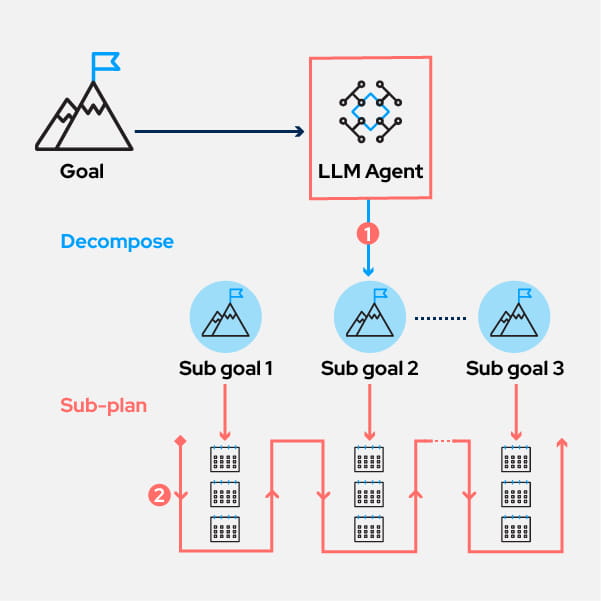
Here, the agent starts by laying out the entire structure of the problem. We let the agent fully break the goal into sub-goals before it begins creating sub-plans.
In the context of the Agentic AI Planning Pattern, this is like setting up a complete roadmap at the very beginning. Once the whole route is visible, the agent can walk through each segment with clarity. This works well when the problem is relatively stable, and we want strong upfront structure.
2. Interleaved Decomposition Approach
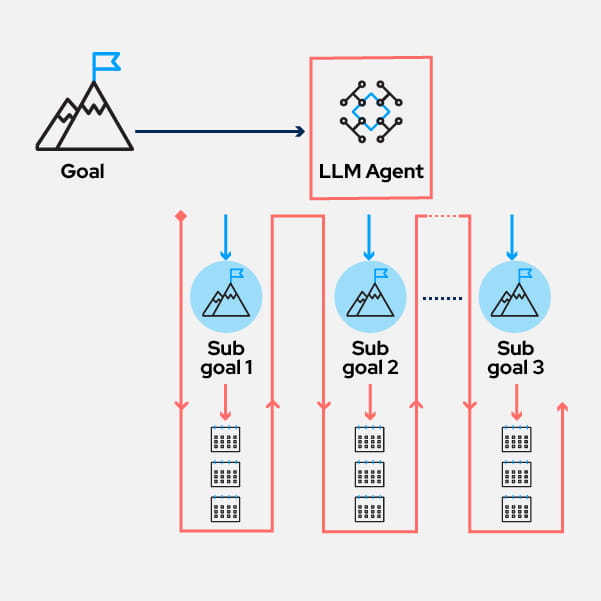
Here, the agent doesn’t try to understand the whole problem upfront. It breaks off a small piece, plans it, executes or evaluates it, and then immediately moves on to the next. This interleaving aligns beautifully with the iterative loop at the heart of agentic planning: Plan → Act → Reflect → Repeat. We allow the agent to evolve its plan as new information appears, making it far more flexible in changing environments.
At its core, this pattern gives an AI system a way to handle a complex problem the way the human brain naturally would:
Understand the goal → Break it down → Act → Evaluate → Adjust → Repeat.
How the Planning Pattern Works?
1. Planning: The “frontal-lobe moment”
This is where everything begins…
The AI interprets the prompt and forms a high-level strategy, similar to how the brain forms an overall plan before starting a task. It identifies the objective, imagines the path to reach it, and sets broad intentions.
2. Generate Tasks: Breaking the big problem into smaller, doable pieces
Once the big picture is clear, the AI creates a list of concrete tasks. Think of this like your brain turning “I need to finish this project” into specific steps: research, outline, draft, refine.Each task is small enough to focus on individually but still contributes to the larger goal.
3. Single Task Agent: Executing one step at a time
This “worker unit” handles each task independently.It follows reasoning patterns like "Plan-Act" and "Plan-Act-Reflect-Repeat" to think and act methodically, completing one task before moving to the next.
After finishing a step, it sends back the result, just like our brain checks how we did after completing part of a job.
4. Replan: Evaluating and correcting the course
Here’s the adaptive part.The system looks at the result of the completed task and asks a very human question:
“Did this work the way I expected?”
If not, it adjusts the plan, maybe changes the next tasks or shifts strategy entirely. In humans, this is the same process as reassessing your plan mid-way when things start going sideways.
5. Iterate: The repeating feedback loop
This loop between task generation and replanning continues until the system gets it right. It’s the AI version of trial-and-error, refinement, and continuous learning—something our frontal lobe does almost automatically when solving real-world problems.Why This Pattern Matters
This planning loop gives AI the ability to work toward complex goals without constant human guidance. It becomes more adaptable, more resilient, and better at handling unexpected outcomes, much like how humans refine their approach when reality doesn’t follow the initial plan.
In short, the Agentic AI Planning Pattern is an engineering attempt to replicate one of the most powerful features of the human brain: structured thinking that evolves with every step.
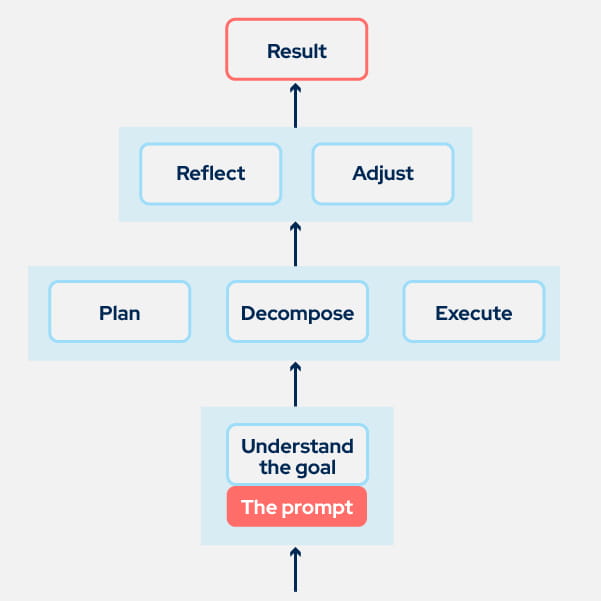
We have focused on two Planning approaches:
1. Plan-Act-Reflect-Repeat
In this paradigm, an AI agent repeatedly cycles through reasoning, acting (e.g. calling a tool), observing the result, and then reasoning again — continuing this “Think → Act → Observe → Think …” loop until it resolves the task. This incremental and interleaved structure lets the agent adapt dynamically based on actual intermediate feedback, making it well-suited for tasks where each step depends on what happened before and the outcome is uncertain. However, because the language model is invoked at every reasoning step with full context and previous steps included, Plan-Act-Reflect-Repeat tends to consume many tokens, leading to inefficiency and potentially slower overall performance for long multi-step tasks.

2. Plan-Act:
This framework takes a different tack. Rather than interleaving reasoning and observation, a Plan-Act-style agent first constructs a complete plan up front, deciding all the necessary steps, what tools to call, and in what order, without immediately executing them. After planning, the agent executes the plan (tool calls), gathers all results, and then uses a “solver” phase to synthesize the final answer based on that evidence. By decoupling reasoning from observation and avoiding repeated back-and-forth calls to the language model, Plan-Act can drastically reduce token usage and improve efficiency studies report up to ~5× token efficiency and slightly better accuracy on some benchmarks compared to Plan-Act-Reflect-Repeat. The tradeoff is reduced flexibility: because the plan is fixed before any actual observations, Plan-Act may struggle if intermediate tool outputs are unexpected or if the task requires adaptive, conditional decision-making.
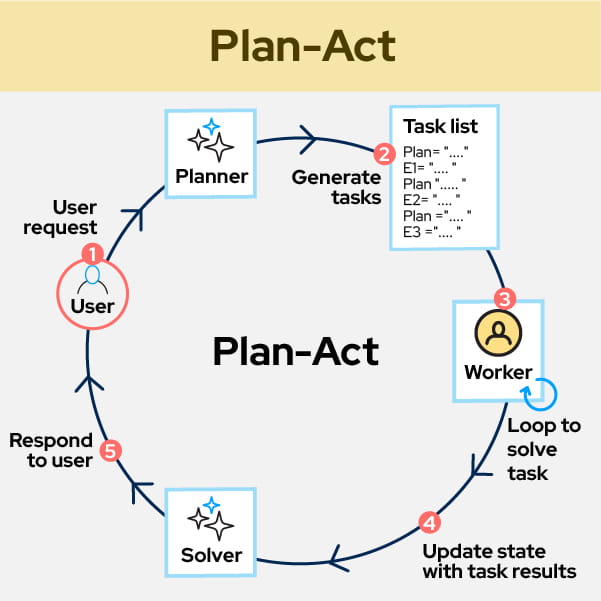
When you put the Planning Pattern: Plan-Act-Reflect-Repeat, and Plan-Act together, they give an AI a steady way to work through complicated tasks. Each one plays a different role; one helps break the work into smaller pieces, another lets the model think while it interacts, and the last one pushes it to map things out before taking action. The combination makes the whole process more organized and keeps the system from jumping around or losing track.
Glossary: Key Concepts Explained
| Term | Explanation |
|---|---|
| Planning Pattern | An agentic AI design pattern where the system plans before acting, breaks goals into steps, executes tasks methodically, and adjusts the plan as results come in. |
| Task Decomposition | The ability to split a complex objective into smaller, actionable tasks that can be completed one by one without losing the overall goal. |
| Replanning | A checkpoint step where the system evaluates progress, detects unexpected outcomes, and updates the plan or task list to stay aligned with the goal. |
| Plan-Act | A planning approach where the agent creates a full plan up front, then executes it and synthesizes a final answer from gathered evidence. |
| Plan-Act-Reflect-Repeat | An iterative approach where the agent cycles through planning, acting, observing results, and refining the next step—useful when outcomes are uncertain and the workflow must adapt. |
Frequently Asked Questions (FAQ)
What is the Agentic AI Planning Pattern?
The Planning Pattern helps AI systems work toward complex goals by creating a plan, breaking it into tasks, executing step by step, and adjusting when results differ from expectations.How is planning different from “one-shot” prompting?
One-shot prompting produces a single response. Planning introduces structure: task decomposition, checkpoints, and iterative improvement so the system can adapt while it works.When should enterprises use Plan-Act vs Plan-Act-Reflect-Repeat?
Plan-Act is a strong fit when the problem is stable and efficiency matters. Plan-Act-Reflect-Repeat is better when outcomes are uncertain and the system must adapt based on intermediate results.Why is replanning important in enterprise workflows?
Replanning prevents brittle automation by allowing the system to detect exceptions, correct course, and keep progressing without silently compounding errors.Does planning make agentic AI more governable?
Yes. Planning creates inspectable steps and checkpoints, making it easier to add policies, logging, and controls around how decisions are made and actions are executed.Discover how the Agentic AI Planning Pattern can improve your workflows with TotalAgility: request a demo now.
More in the Agentic AI Design Patterns series
This article explores one of the core Agentic AI design patterns in depth, while the rest of the series provides detailed breakdowns of the other patterns that shape enterprise-grade AI systems.

Agentic AI Design Patterns for Enterprise AI Systems
This article is part of a dedicated series exploring how agentic AI design patterns enable reliable, governable, and scalable enterprise AI agents. This post explains how the Planning Pattern enables AI agents to decompose complex goals into structured steps, coordinate long-running tasks, and operate with greater predictability in enterprise environments.
More in this series:
- Why building truly agentic AI means engineering the whole brain - A sharper take on agentic AI: why an LLM alone is not enough, and why memory, tools, planning, reflection, and coordination must work together as one system.
- Agentic AI Design Patterns: An Overview - A high-level introduction to agentic AI systems and the core design patterns used in enterprise environments.
- The Agentic AI Reflection Pattern - How structured self-review loops improve accuracy, reduce hallucinations, and introduce validation safeguards in enterprise AI systems.
- The Agentic AI Multi-Agent Pattern - Designing collaborative AI systems with specialized roles and orchestration logic.
- The Agentic AI Tool-Use Pattern - Enabling AI agents to call tools and APIs to retrieve real data and execute enterprise actions.

Gartner® recognizes Tungsten Automation again as a Leader in the second edition of the Magic Quadrant™ for Intelligent Document Processing (IDP).
Read the report

Request a demo
With a personalized demo you can see firsthand how we can help you drive innovation, increase productivity and improve your bottom line.