
How to Build Enterprise Grade AI Agents with Agentic Design Patterns
Well, here we are in February 2026, and you might have heard a lot about AI doing incredible things that make our lives easier and at the same time raise concerns about how much control we should give it. Because of this growing tension, maintaining the right balance between capability and control is exactly where Agentic AI Design Patterns come into the picture.
Agentic AI Design Patterns are emerging right at the center of this tension, acting as the architectural blueprints that help enterprises build AI systems which are not only powerful and autonomous, but also predictable, governable, and aligned with business or user intent. These patterns aren’t just about writing better prompts or chaining tools together. They represent a deeper shift in how we think about AI: moving from single-turn interactions to dynamic, goal-driven agents capable of planning, reasoning, self-correcting, verifying their own steps, and collaborating with other agents or humans.
These Agentic AI Design Pattern for Enterprises includes the following:
- Multi-Agent Pattern
- Reflection Pattern
- Planning Pattern ("Plan-Act" and "Plan-Act-Reflect-Repeat")
- Tool Use Pattern (With a Tool Registry)
Note: Every agent we see today is, in some way, a variation of these design patterns.
From Single-Turn Prompts to Goal-Driven AI Agents
On a similar note, I’m going to share some of the Agentic AI Design Patterns we at Tungsten Automation have been exploring. These patterns are already helping us streamline internal workflows and, more importantly, simplify and enhance the experience for our clients.
Top 4 Agentic AI Design Patterns at a Glance
Reflection Pattern
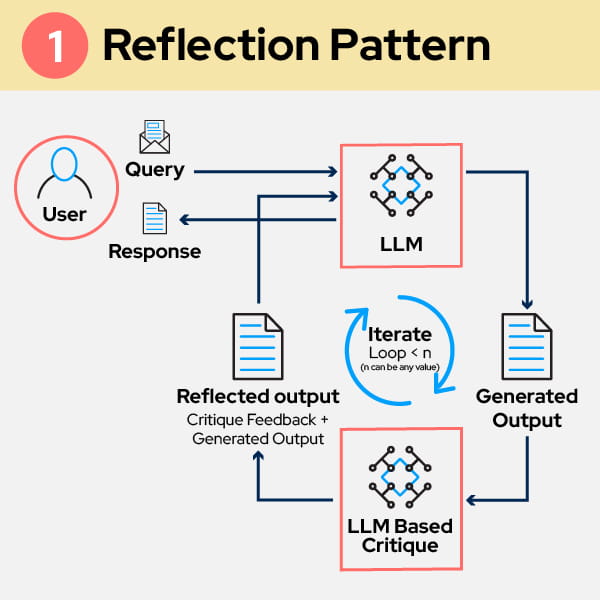
The Reflection Pattern introduces a self-review loop where an AI agent evaluates and refines its own output
before delivering a final result. Instead of treating the first answer as final, the agent generates, reviews,
and iterates to address gaps, inconsistencies, or unsupported claims.
In enterprise settings, this pattern is
often used to improve factual accuracy, reduce hallucinations, and standardize responses across teams. It is
especially helpful when outputs are customer-facing or feed downstream processes where mistakes are costly.
Reflection can be implemented as a lightweight second pass or a stricter validation step with criteria and
checks tailored to the use case.
Tool-Use Pattern
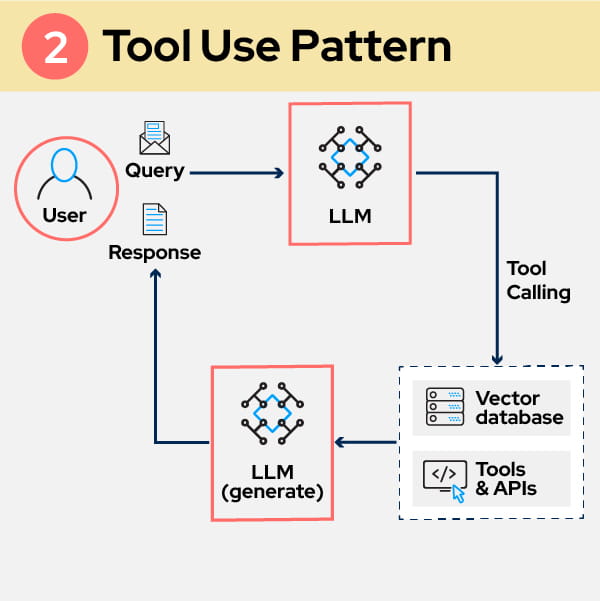
The Tool-Use Pattern enables AI agents to interact with external systems such as APIs, databases, document
stores, and enterprise applications. Rather than relying only on the model’s internal knowledge, the agent can
fetch current data, look up records, run calculations, or trigger workflows.
This pattern is a strong fit for
tasks like customer support, document processing, procurement, and IT operations where answers depend on
up-to-date information. It also supports better traceability, because the agent can cite tool outputs as the
basis for decisions. In practice, robust tool-use requires clear permissions, input validation, and guardrails
to prevent unintended actions.
Planning Pattern
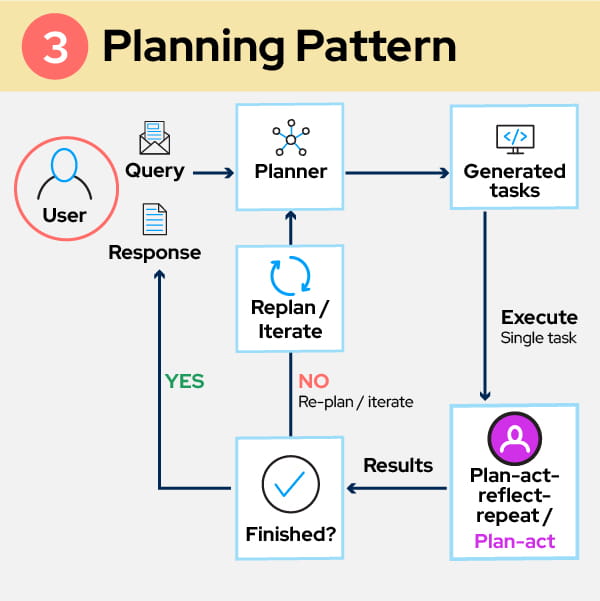
The Planning Pattern helps an AI agent break a complex objective into structured steps before execution. It enables an AI agent to solve complex objectives using either a Plan-Act or Plan-Act-Reflect-Repeat approach. The agent begins by decomposing a goal into manageable sub-tasks, identifying dependencies, tools, and constraints before execution.
In a Decomposition-First (Plan-Act) approach, the agent lays out the full roadmap upfront, creating a complete plan before acting. This provides strong structure and predictability and works well for stable, well-understood problems.
In an Interleaved Decomposition (Plan-Act-Reflect-Repeat) approach, planning and execution are iterative. The agent plans a small step, acts, reflects on the outcome, and then adjusts the plan as new information emerges. This makes the pattern highly adaptable to dynamic or uncertain environments.
By separating planning, execution, and reflection, the pattern improves transparency, control, and adaptability, allowing AI systems to handle complex, long-running workflows in a way that mirrors human problem-solving: understand → break down → act → evaluate → adjust → repeat.
Multi-agent Pattern
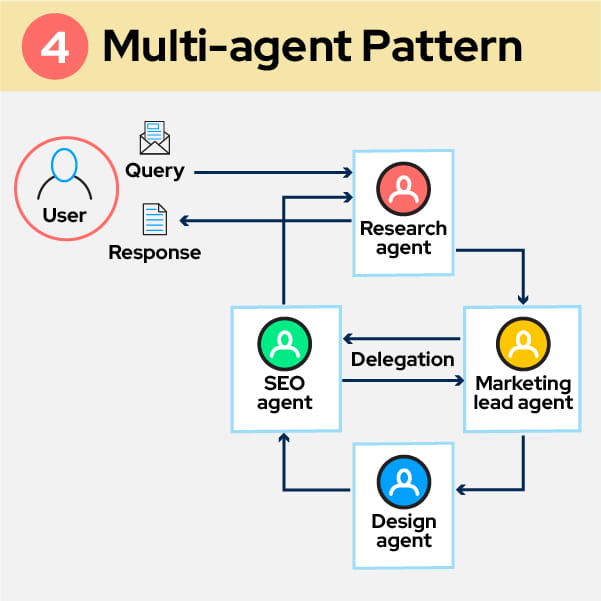
The Multi-Agent Pattern structures an AI system as a coordinated team of specialized agents rather than a single, monolithic model. A managing (or orchestrator) agent owns the overall goal and controls the lifecycle of a case, while worker or micro-agents operate as agents-as-a-service, each responsible for a well-defined task such as planning, research, extraction, validation, decisioning, or execution. Each worker agent runs with its own tools, constraints, and scope, allowing tasks to be handled independently and in parallel when needed.
In an enterprise case management context, this maps naturally to how work is already organized. A managing agent coordinates and controls the case end-to-end deciding what needs to happen next, invoking the right worker agents, and reconciling their outputs. While micro-agents fulfill specific jobs associated with that case. These jobs can run synchronously or asynchronously, with full visibility into each iteration, outcomes, and handoffs. This approach improves reliability and scalability by separating concerns, reducing cognitive load on any single model, in turn improving the worker agent's task focus, and enabling transparent orchestration, clear ownership, and conflict resolution when agents disagree, exactly what is required for complex, multi-step workflows such as onboarding, claims handling, and compliance reviews.
In many ways, Agentic AI Design Patterns are the new "design language" of modern AI development. They help product builders define how an AI system should behave when it explores the web, processes, sensitive data, orchestrates multi-step workflows, or recovers gracefully from mistakes. Whether you're building agents for research, automation, customer support, complex data transformation, or enterprise-grade decision-making, these patterns bring clarity. They help ensure:
- Tasks are decomposed intelligently
- Risks are managed at every layer
- Outputs are validated using multiple strategies
- Autonomy is balanced with oversight
- And the entire system remains transparent and auditable
Rather than going to zero-shot mode (directly prompting the LLM), we at Tungsten Automation are inclined towards following the Agentic AI Design Pattern that can reason, execute, iterate over the result multiple times with multi agent to provide the best output! Makes sense, right?
To understand it better, we will give a brief description of each pattern. Before we dig into the Agentic AI Design Patterns in detail, lets understand the Real Progress and Problems shaping AI Right Now…
A World Moving Too Fast to Predict: Why AI’s Story Is More Nuanced Than Ever?
As I’m writing this, the pace of AI updates is so unpredictable that Google or OpenAI could drop a major release while I’m still typing this paragraph. That’s honestly how fast things are moving right now. And of course, we can’t ignore the AGI conversation. Not sure if it is coming in the near future but Google DeepMind certainly stirred the conversation with the introduction of Hope, a model designed for continuous learning. One of its most remarkable aspects is that it tackles "catastrophic forgetting" the long-standing problem where a model becomes less accurate or even "forgets" older knowledge when exposed to new tasks.
It is also becoming clear that AGI isn’t about passing human-level benchmarks or having perfectly human-like conversations. The definition itself is evolving. Today, researchers describe intelligence as the ability to adapt under constraints, limited computing, memory, and energy just like humans do every day. So, AGI isn’t necessarily about replicating a human mind; it’s about creating a system that can continuously learn and adapt even when resources are tight. Does it make sense? Check this out - What the F*ck Is Artificial General Intelligence?
And honestly, this shift in definition explains a lot of what we’ve been seeing in public conversations. For 2-3 years I have been observing that there is a lot of negative noise about AI, and honestly, I’m not surprised!
The Chevrolet Tahoe for $1 incident, where a dealership’s AI chatbot was manipulated into agreeing to sell a 2024 Chevy Tahoe for just a dollar…
Replit’s AI agent accidentally deleting a live production database…
Unnecessary AI developments (LLM wrappers called as AI agents), and failure of agents due to poor design, weak evaluation, and lack of guardrails, have fueled growing skepticism and predictions of an "AI bubble" bursting.
And the list goes on with examples people love to cite.
Why Enterprises Need Structured Agentic AI Systems
But here’s the thing, let’s be honest, AI has also made a lot of our work easier, and in many cases, safer, faster, and more consistent. From automating repetitive tasks, to summarizing massive documents in seconds, to helping developers debug code, to giving small teams superpowers they never had before, it’s not all doom and gloom.
Yes, there are failures. Yes, there are risks. Yes, there are headlines designed to scare.
But there’s also progress, innovation, and real-world impact happening quietly in the background every single day.
The real story isn’t that AI is "good" or "bad".
The real story is that we’re still learning how to use it responsibly, how to design safeguards, how to build better workflows, and how to treat AI like what it actually is, a tool, not magic, not a replacement for judgment, and definitely not something that should run unsupervised in production (as many companies have learned the hard way).
So, while the negative headlines get clicks, positive transformation is happening steadily with one workflow, one automation, and one solved problem at a time.
And that’s exactly why we now need a clearer way to build AI systems that don’t just act intelligently but act responsibly as well. One of the many most effective solutions can be the an Agentic AI System with the right design pattern that can bring structure, reliability, and accountability to the way autonomous systems operate. In TotalAgility, we are implementing different Agentic AI Design Patterns that protect enterprise systems from unintended AI actions, such as forgetting prior decisions, overwriting business rules, or deleting critical data by embedding AI agents into governed, auditable, and reversible workflows.
Discover how the Reflection Pattern can improve your workflows with TotalAgility: request a demo now.
More in the Agentic AI Design Patterns series
This article introduces the core patterns at a high level. Follow-up posts will explore each pattern in detail, with practical examples and architectural considerations for enterprise use cases. Stay tuned!
Frequently Asked Questions (FAQ)
What are Agentic AI design patterns?
Agentic AI Design Patterns define how AI systems plan, act, validate results, and adapt over time, enabling structured and goal-driven behavior beyond single-turn prompts.How is agentic AI different from prompt-based AI?
Prompt-based AI produces one-off responses, while agentic AI operates in iterative loops that include planning, execution, reflection, and adjustment.Why do enterprises need agentic AI systems?
Enterprises need AI systems that are reliable, governable, and auditable. Agentic AI Design Patterns introduce structure and safeguards that reduce risk while supporting autonomous workflows.Can agentic AI systems help reduce AI failures and unexpected behavior?
Yes. By introducing planning, reflection, validation, and clear role separation, agentic AI systems reduce hallucinations, limit unintended actions, and make AI behavior more predictable in production environments.Glossary: Key Concepts Explained
| Term | Explanation |
|---|---|
| Reflection Pattern | An agentic AI design pattern in which a model evaluates and refines its own output through a structured self-review loop before producing a final result. |
| Self-Critique | A mechanism where an AI system assesses generated responses against criteria, evidence, or constraints to identify errors, gaps, or unsupported claims. |
| Retrieval-Augmented Generation (RAG) | An approach that combines document retrieval with text generation, grounding responses in external sources rather than relying only on internal model knowledge. |

Agentic AI Design Patterns for Enterprise AI Systems
This post is part of a dedicated series exploring how Agentic AI Design Patterns help enterprises build reliable, governable, and scalable AI agents. Here we provide an overview of the Reflection, Multi-Agent, Tool-Use and Planning Patterns.
More in this series:
- Why building truly agentic AI means engineering the whole brain - A sharper take on agentic AI: why an LLM alone is not enough, and why memory, tools, planning, reflection, and coordination must work together as one system.
- The Agentic AI Reflection Pattern - How structured self-review loops improve accuracy, reduce hallucinations, and introduce validation safeguards in enterprise AI systems.
- The Agentic AI Multi-Agent Pattern - Designing AI systems where specialized agents collaborate to handle complex, multi-step workflows.
- The Agentic AI Tool-Use Pattern - Enabling AI agents to interact with external tools, APIs, and enterprise systems to take real-world action.
- The Agentic AI Planning Pattern - How structured planning and task decomposition support long-running, goal-driven AI workflows.

Gartner® recognizes Tungsten Automation again as a Leader in the second edition of the Magic Quadrant™ for Intelligent Document Processing (IDP).
Read the report

Request a demo
With a personalized demo you can see firsthand how we can help you drive innovation, increase productivity and improve your bottom line.