
PII Protection: Building Awareness beyond Compliance
In today’s digital landscape, organizations across all sectors—financial services, healthcare, government, education, and non-profits—are grappling with the challenge of protecting Personally Identifiable Information (PII). With increasing regulatory scrutiny and the rising threat of data breaches, fostering a culture of PII protection is not just a compliance issue; it’s a critical business imperative.
In our previous blog ‘Why Redaction Matters, even for Archived Documents’ we outlined best practices for the challenges all organisations are facing on protecting PII information.
In this blog we explore strategies for embedding privacy awareness into daily operations, training staff, and leveraging technology to minimize human error.
The Importance of PII Protection
Statistics Highlighting the Need for PII Protection:
In 2023, the financial sector accounted for 27% of all data breaches, making it the most breached industry.
In 2023, 55% of healthcare organizations globally experienced an accidental or deliberate data leak from internal sources. Healthcare was the most breached sector in 2024, accounting for 23% of all data breaches. Healthcare records are extremely valuable to cybercriminals and can be used for many malicious purposes. On average, hackers are able to earn around $1,000 for each set of stolen healthcare records.
80% of companies in the US and 85% of companies in Asia, Europe, Africa, and Latin America say they’ve been successfully hacked in an attempt to steal, change, or make public important data.
In 2025 the average cost of a data breach incident across companies worldwide is 4.44 million U.S. dollars.
These statistics underscore the urgent need for organizations to prioritize PII protection, not only to comply with regulations but also to safeguard their reputation and maintain customer trust.
Regulatory Landscape
Organizations around the world are governed by comprehensive privacy frameworks designed to protect personal information.
Strategies for Building a Culture of PII Protection
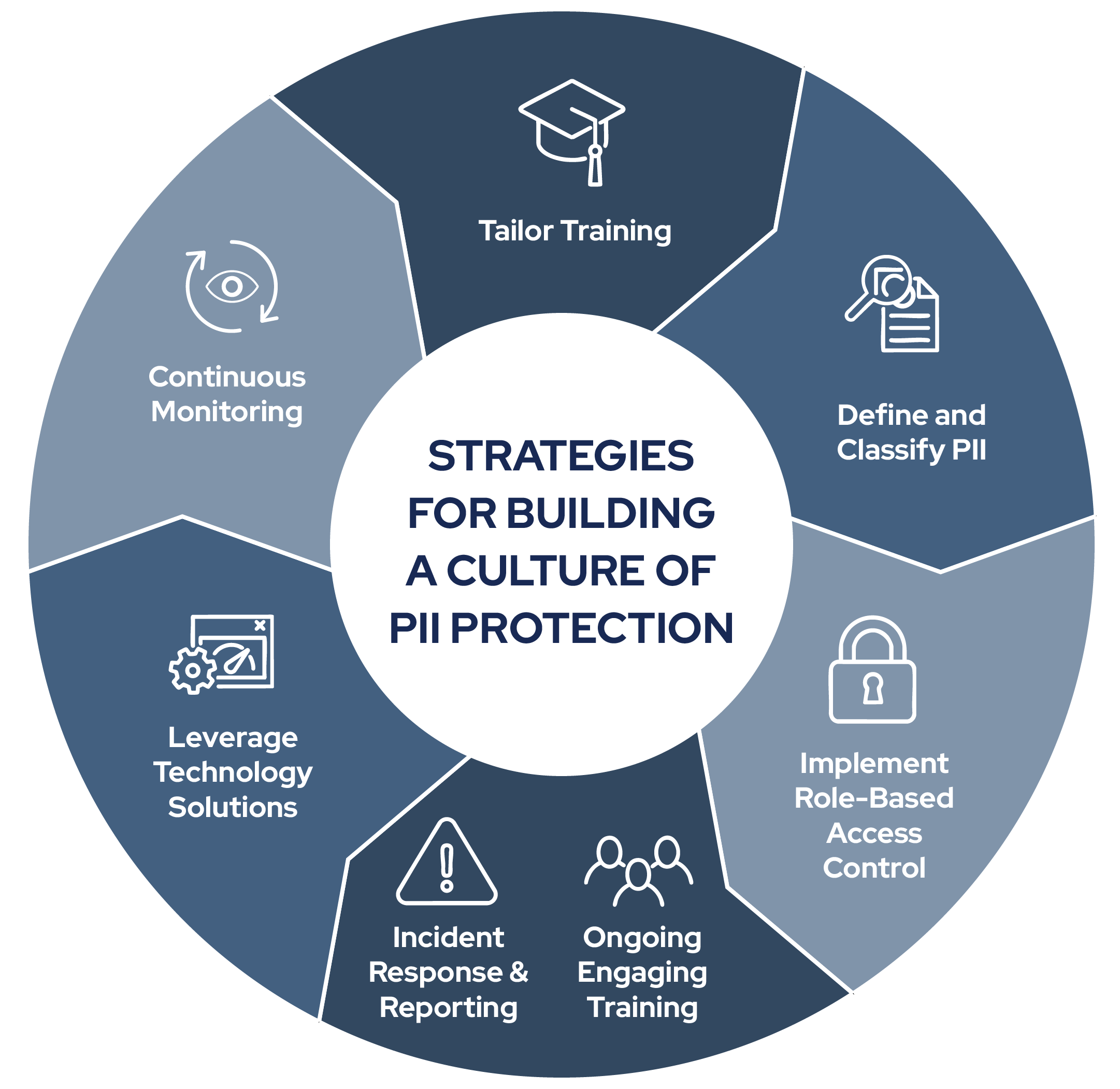
- Tailor Training to Organizational Needs
- Training should reflect the specific types of PII handled and the unique risks of each organization. For example, healthcare organizations must address HIPAA compliance, while educational institutions focus on FERPA.
- Define and Classify PII
- Employees must understand what constitutes PII, including both direct identifiers (e.g., Social Security Numbers) and indirect identifiers (e.g., IP addresses). Classifying PII by sensitivity helps apply appropriate safeguards.
- Implement Role-Based Access Control (RBAC)
- Limit access to PII based on job roles to ensure that employees only access the information necessary for their work. Regularly review and adjust permissions to maintain security.
- Ongoing, Engaging Training
- Provide regular training sessions that include simulations and real-world scenarios. Avoid punitive approaches; instead, foster a culture of learning and responsibility.
- Incident Response and Reporting
- Train staff on recognizing, reporting, and responding to PII incidents. Regularly practice incident response plans to ensure preparedness.
- Leverage Technology Solutions
- Utilize automated PII discovery tools to identify where PII resides across various data environments. Implement Data Loss Prevention (DLP) solutions and encryption to protect PII both at rest and in transit.
- Modern automation platforms like Tungsten TotalAgility offer advanced redaction capabilities that go far beyond manual document review. Leveraging artificial intelligence, TotalAgility automatically detects and redacts sensitive information—such as names, account numbers, and tax file numbers—across both new and archived documents. The platform integrates seamlessly with enterprise content management systems, ensuring that redacted documents are securely handled and all changes are fully auditable. By automating the redaction process and supporting customizable rules, TotalAgility helps organizations consistently protect PII, minimize human error, and meet the stringent requirements of global privacy regulations
- Continuous Monitoring and Improvement
- Monitor data repositories and user activity in real-time to detect breaches or policy violations early. Regularly assess training effectiveness and update content to address new threats.
Building a culture of PII protection is essential for organizations across all sectors. By implementing tailored training programs, leveraging technology, and fostering a proactive approach to data protection, organizations can significantly reduce the risk of data breaches and enhance customer trust. As the regulatory landscape continues to evolve, staying informed and prepared is crucial for success.
Take the first step - Book a Demo to see how Automation can help.


Gartner® recognizes Tungsten Automation again as a Leader in the second edition of the Magic Quadrant™ for Intelligent Document Processing (IDP).
Read the reportRelated resources


Request a demo
With a personalized demo you can see firsthand how we can help you drive innovation, increase productivity and improve your bottom line.